English
  Japanese
Approximately 901 TP3T saved per report, freeing up over 2,000 hours per year. The reason why a company that could use AI internally still relied on external professionals.
Kimete Co., Ltd.

Issues before implementation
- Reporting tasks: Daily reports and business negotiation reports were based on the notes or memories of the person in charge, and were often put off until the evening when a block of time was available.
- AI utilization: While employees were proficient in using AI, their methods remained within their own control. Successful methods were not shared within the organization.
- Issuing quotations: This process relied on requests to the back office, and once the person in charge left work, it would stop until the next business day, slowing down the pace of business negotiations.
Effects after implementation
- Reporting time per item reduced from approximately 10 minutes to approximately 1 minute (a reduction of approximately 901 TP3T). The company estimates this to be approximately 2,100 to 2,900 hours per year, or approximately 4.3 million to 5.8 million yen per year. As reporting can now be completed immediately after a business negotiation, the number of reports itself has also increased.
- AI utilization: From individual ingenuity to a system used by everyone. It became established even among employees who had been with the company for three months, and after the support period ended, the company was able to complete everything from identifying bugs to fixing them and re-releasing the product in-house.
- Quotation issuance: Request and wait for the next business day → Sales representative issues it on the spot. The request process itself has been eliminated.
table of contents
Company Introduction
Kimete Co., Ltd. is a company that provides recruitment consulting and talent assessment services, primarily for new graduate recruitment.It was launched in May 2018 as a business unit of Musashino Co., Ltd.With the aim of accelerating management decision-making and enhancing service expertise,Effective May 1, 2026, it will be spun off as a subsidiary of the company.Yes, the new President and CEO is Atsushi Komine, who has been in charge of the business since its inception.
The slogan we will be promoting is"Eliminate mismatches and maximize corporate value.""We don't just want to provide tools and be done with it; we want to be a presence that supports our employees' success even after they join the company," says Mr. Komine.
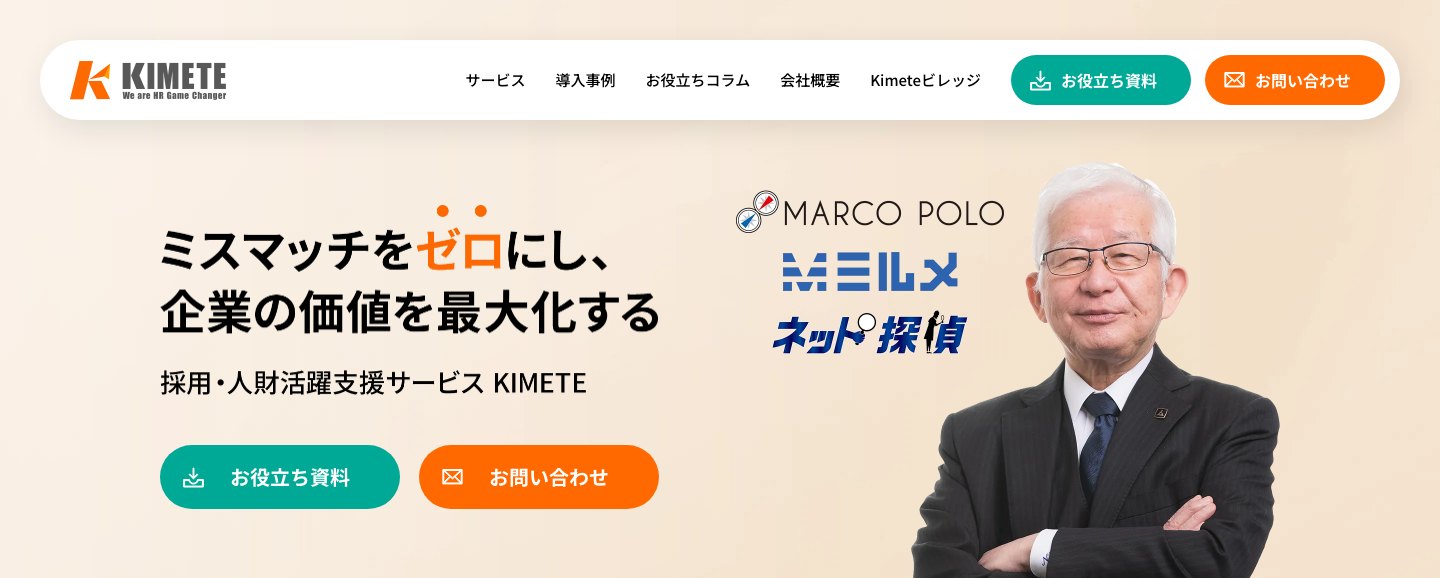
Therefore, the company's service does not isolate just one step in the recruitment process, but rather encompasses recruitment design, candidate pool formation, selection/assessment, offer follow-up, onboarding/placement, and training/promotion.All six stepsThis is the target group. The design goes beyond simply hiring; it's a continuous process that encompasses seeing how the individual thrives within the organization.
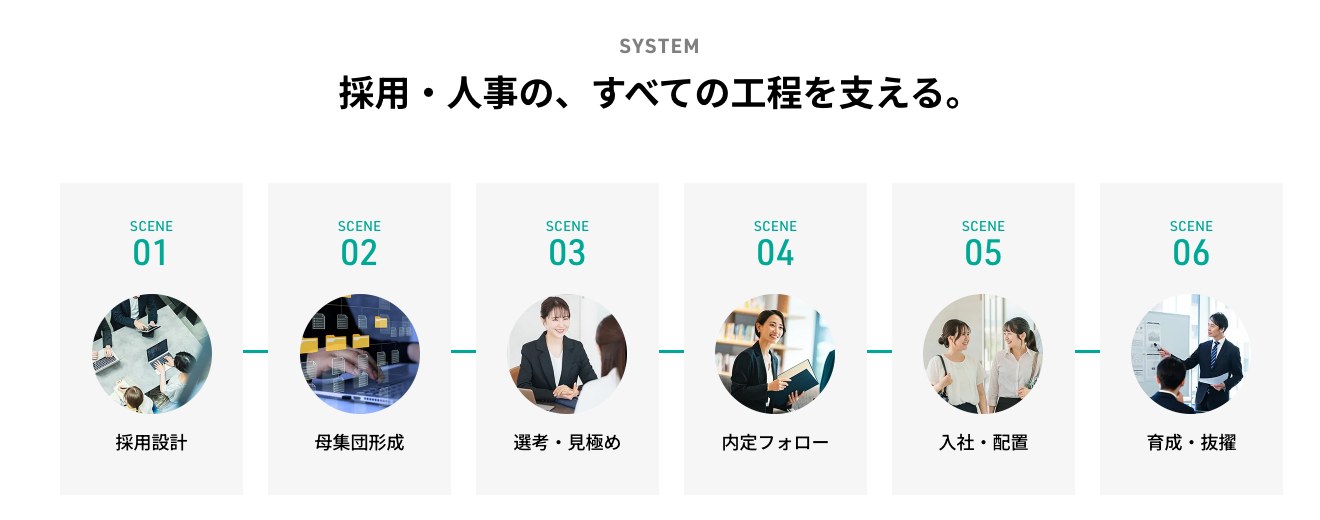
At its core is an aptitude test that visualizes the personality traits and work motivations of test-takers based on psychometrics."Marco Polo"Its key feature is that it can be used not only for determining whether to hire someone, but also for deciding on their placement and promotion after they join the company. Additionally, it measures processing ability in 15 minutes."Mirme"Experts investigate candidates' online information to visualize hiring risks."Internet Detective"We offer:
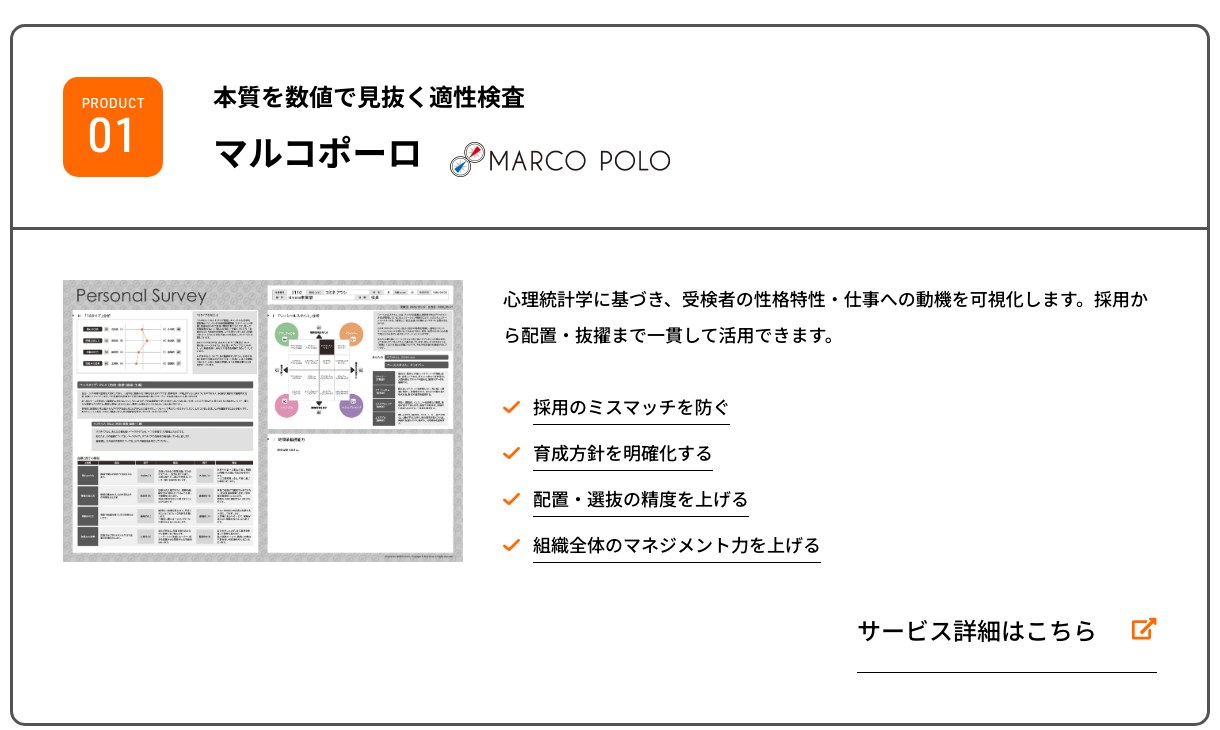
It's not just about the tools. Recruitment professionals will work alongside you from planning your recruitment strategy and designing interviews to providing post-offer follow-up, helping you build a fully-fledged recruitment system that your company can manage on its own."Recruitment Consulting"Furthermore, there is a membership-based community where you can learn about the systems of successful companies through sharing of recruitment case studies and on-site visits."Kimete Village".For details about the service, please visit the company's website.It's all summarized here.
We will support you until you can handle recruitment entirely in-house.This approach also aligns with the company's own approach to AI utilization, which will be discussed later. The launch of the new company and the implementation of AI utilization happened almost simultaneously.
Issues before introducing generative AI
The first challenge the company cited was"Report"That's how it was. Daily reports and business negotiation reports were based on the notes or memories of the person in charge.I'll put it off until the evening when I have a block of free time.That's how it was. The level of detail varied depending on the writer, and there was also inconsistency in the timing.
While the company had accumulated information such as records of business negotiations, whether or not to use that information was left to the discretion of the individual employee."We have the information, but it's being handled at an individual level."The degree to which it was being used varied greatly from person to person.
However, the companyIt wasn't a company that didn't use AI at all.Rather, each employee tried out AI in their own work and was able to use it to a reasonable extent.However, the results did not spread horizontally.That's the structure. Mr. Komine reflects on it as follows:
Without external pressure, everyone keeps things black-boxed within their own area. You have no idea whether others are doing what you are doing. Therefore, I think external forces are extremely effective when it comes to formalizing things that management wants to standardize internally.
Jun Komine, President and CEO of Kimete Co., Ltd.
Even as more people became capable, the methods remained confined to each individual. It became unclear who could do what, and successful methods weren't shared.Individual improvement and becoming part of an organization's system are two different things.The company chose an external partner to take on the role of "transforming individual ingenuity into a form that everyone can use."
Benefits of using generative AI
The biggest change was in the reporting process.The creation process, which previously took about 10 minutes per item, has been reduced to about 1 minute.It is being done. Looking at it per item,A reduction of approximately 90%According to the company's estimates, approximately 20 people are responsible for this task, with each person performing it 3 to 4 times a day.180-240 hours per monthWhen converted to a yearApproximately 2,100 to 2,900 hoursThis will result in a reduction. For a company with about 30 employees,The reporting tasks alone have returned to a level that would normally take up the time of one person.This is the calculation. If we convert it to an amount based on the company's personnel costs,Approximately 4.3 million to 5.8 million yen per yearThis corresponds to [the relevant category].
The system has two stages.When you input a transcript of a business meeting, the system automatically generates a document that conforms to the company's internal reporting format. Pasting this document directly registers it as a visit record in the CRM system.The only physical work the person in charge does is pasting the documents and checking the content.
We also improved the accuracy of the registration. Previously, customer names were often registered as different companies due to variations in spelling, such as the presence or absence of "Co., Ltd." or differences in full-width/half-width characters. We have now addressed these inconsistencies by matching them with existing customers.If there is a possibility of duplication, we will ask for confirmation before registration.By automatically determining the reporter,Approximately 6 steps were eliminated per project..
In response to requests from the field to "complete tasks on a smartphone while on the go," we have also prepared a simplified version for smartphones.The report comes in a few minutes after the business meeting ends.This is because we've refined it to this final form.
* The figures are based on perceived values gathered during interviews and the company's calculations based on those values. They are not actual measured values. Monthly time savings are based on the assumption of "approximately 9 minutes reduction per case × 3-4 cases per person per day × approximately 20 people × 20 business days per month". Annual time savings are calculated by multiplying this by 12, and the range will change if the assumptions change. "Per employee" is calculated based on an annual standard of 1,920 hours (8 hours × 240 days). The amounts are estimates based on the company's labor cost per hour.
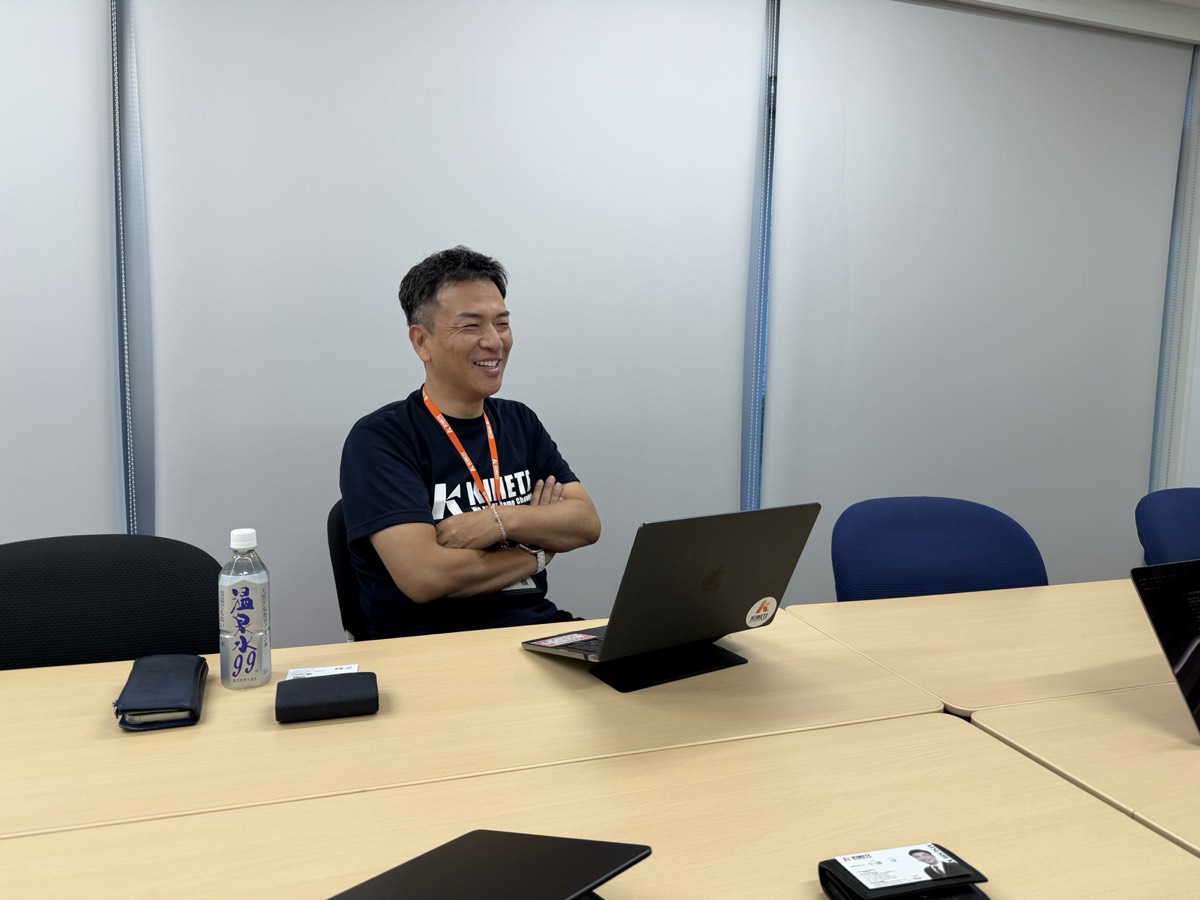
The changes weren't limited to just time. What used to be written all at once in the evening could now be completed within minutes of a business meeting ending. Mr. Komine describes this change as follows:
The mental burden of spending the day thinking, "I have to do that," has been significantly reduced.
Jun Komine, President and CEO of Kimete Co., Ltd.
A work style that assumes you will leave all your tasks until the evening,It changed to a format where it could be completed within the same day..
There were also some unexpected effects.The "number" of reports itself has increased."We've seen an increase in reports that we haven't received before." It seems that this practice is naturally becoming established even among employees who have recently joined the company.
When issuing a quote, the cost of the tool is not the cost of the tool.The business process itselfThis has been revised. Previously, it was a request-based system through the back office, and once the person in charge left work, issuance would stop until the next business day."First of all, why are you requesting this service?"As a result of redesigning based on that question,The request process itself has become unnecessary, and sales representatives can now issue documents on the spot.Mr. Komine recalls that it was a review that would have been difficult to undertake solely within the company.
There's another document that I've restructured using the same approach as the quotation.Issuance of trial aptitude test resultsPreviously, the process involved manually securing an account, changing the name and registering, sending the issued URL via chat, updating the list after the exam was completed, and checking the deadline daily. Now, when you submit the application form, the process of checking for previous exam history, assigning an available account, recording it in the list, and notifying the assigned room is all handled automatically.It runs automatically..
There have also been changes in new employee training. We've organized customer service history and product manuals, which were previously buried within individual interactions, into a format that AI can search and answer questions from.I can now find out "how that matter went" on my own without having to ask an experienced employee.According to Mr. Komine, it is actually the younger employees who are using it. The company has taken over the operation, and they are also able to add data themselves.
After the support period ends,The company identified the system bug itself, fixed it, and relaunched it.We are doing it.Three days after the final meetingThat was the issue. The problem was that the list would not load properly once the number of users exceeded a certain limit. We handled everything in-house, from troubleshooting and fixing the problem to relaunching the service.
Although we included a document outlining the correction procedures at the time of handover, we don't know if it will actually be used.We can make changes ourselves without having to contact the vendor.—That situation was proven after the contract ended.It became so.
Future outlook
Mr. Komine described another change happening within the company."Expansion of ideas"This is how it's expressed. Instead of just using AI, some employees have started thinking that they should simply turn the problems they face into a system.We are moving from a stage of using pre-defined tools in a prescribed way to a stage of creating our own methods..
The fact that the plan, which was initially expected to take four months, was completed in three months was due to the company's quick response. The next topic being discussed is:Development of business infrastructureWith the company split, management requirements have also changed, and reviewing our internal systems remains an ongoing consideration.
Finally, we asked Mr. Komine for advice for companies considering implementing AI. He replied:
When you're sick, you can't diagnose yourself, right? That's why you go to a doctor. It's the same principle; there's value in having someone else examine you.
Jun Komine
We didn't bring in an external company because our employees weren't able to use AI.Because it was usable, there was a need for someone to take it and transform it into a system that everyone could use, rather than keeping it confined to individuals.—The company's three months were dedicated to that purpose..