English
  Japanese
Passing on demonstration sales and product development know-how to AI! A successful DX example that eliminated reliance on individual expertise.
Copa Corporation

Issues before implementation
- Increase in tasks not directly related to sales (e.g., audit response, document creation)
- Slowdown in the speed from product development to sales
- The difficulty of transferring person-dependent know-how and the delay in training new employees.
Effects after implementation
- Streamlining the creation of presentation materials through AI-powered automatic generation of speeches.
- Significant reduction in product development time
- Visualizing culture and know-how, and standardizing in-house training through chatbots.
table of contents
Company Introduction
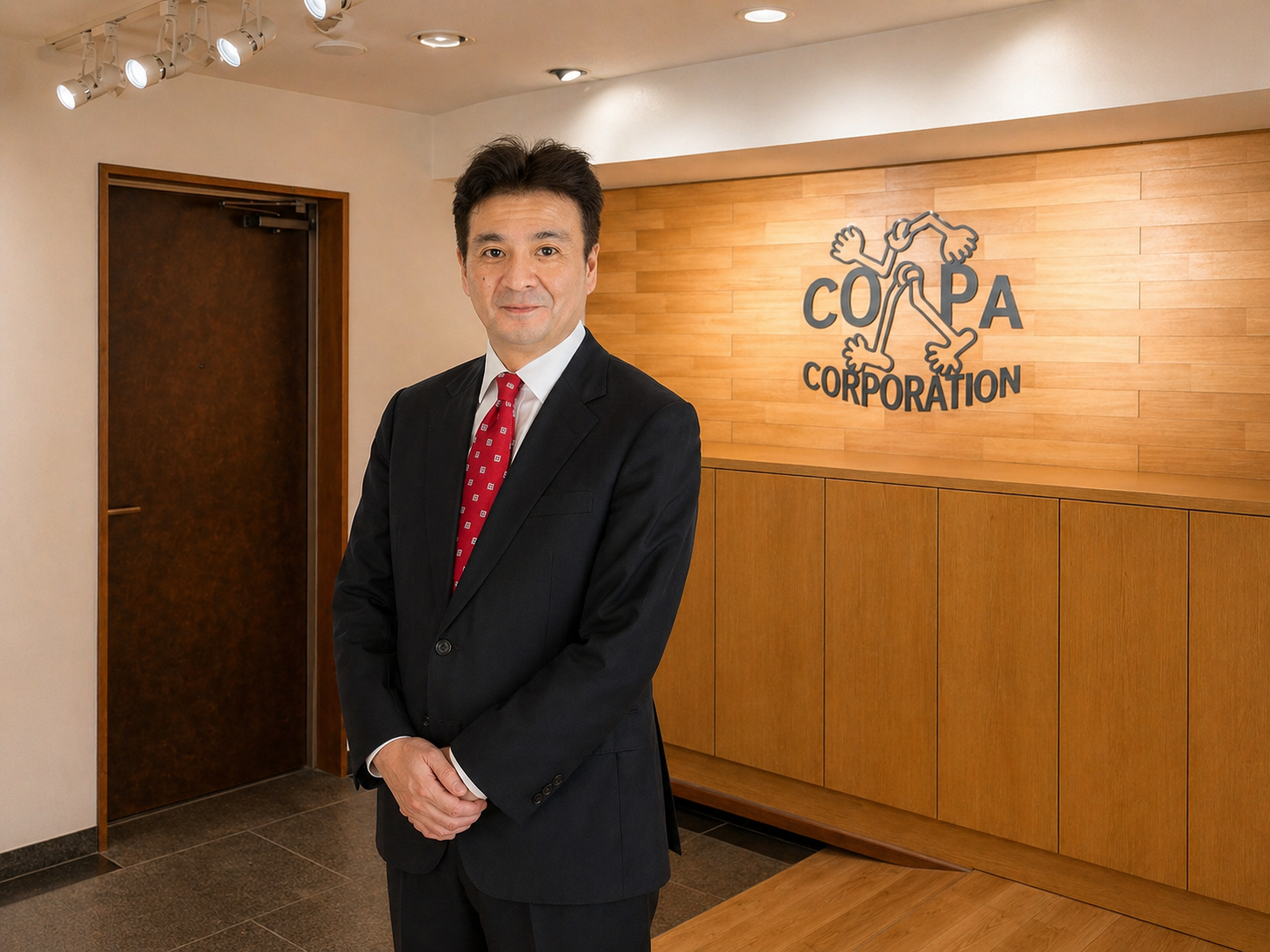
Copa Corporation, headquartered in Ebisu, develops original products and operates a unique business model where its own demonstrators sell them in stores nationwide. Founded in 1998, the company was listed on the Tokyo Stock Exchange Mothers market (now the Growth market) in 2020. As of 2025, it will be in its fifth year of listing.
With the philosophy of "Selling kindness and inspiration to earn smiles and gratitude, and making it a source of sustenance for everyone," and embodying the slogan, "Focusing on '1' and walking the royal road of commerce, we will become happy together with our customers," we have created one unique product after another that makes the world a more convenient place.
A major strength of our company is our ability to directly communicate the appeal of our products to consumers by handling everything from planning and development to sales ourselves. This allows us to directly convey the developers' intentions and the product's appeal to consumers, and establish a system that enables us to quickly feed back primary market information into product development.
Issues before introducing generative AI
Since going public, we have seen a surge in non-sales-related tasks, such as audit compliance, strengthening governance, and establishing J-SOX compliance and double-check systems. As a result, internal resources have not been adequately allocated to product development and sales activities, making it difficult to conduct business with speed.
Furthermore, the organization's growth and increased employee turnover have revealed a problem: the know-how and demonstration sales culture, which had been accumulated on an individual basis, are not easily passed on to new employees. This creates a vicious cycle where it takes time to translate this knowledge into manuals and documents, delaying the integration of new employees into productive workforce members.
Thus, the company continued to face a situation where it could not allocate sufficient resources to what it should have prioritized: "creating marketable products" and "passing on on-the-ground expertise," potentially impacting its competitiveness.
Benefits of using generative AI
To address these challenges, we have fully implemented generative AI. The first significant improvement is the speed from product development to sales preparation. This process, which previously took more than six months, has been drastically shortened.
We trained AI with the know-how and sales pitches accumulated within the company to automatically generate scripts for demonstrations. This allowed us to reallocate human resources to other tasks and significantly reduced the effort required to create materials.
Furthermore, by utilizing chatbots for internal knowledge sharing, previously individualized information has become visible, creating an environment where anyone can perform their duties at a consistent level. This has improved the speed of training new employees, achieving a balance between the quality and efficiency of education.
Future outlook
Our future goal is to establish an "AI-powered e-commerce system" utilizing generative AI. We envision a system where a staff member inputs product information into the AI, which automatically generates sales scripts and provides end-to-end support for online sales.
Furthermore, with an eye on reducing losses due to excess inventory and the environmental impact, we are exploring a shift to a build-to-order business model. Having previously experienced the disposal of 900 million yen worth of inventory due to the COVID-19 pandemic, we have reaffirmed the importance of "the ability to sell out" and are working on highly accurate sales forecasts using AI and optimizing market launch timing.
Ultimately, we aim to create an organization where all employees can focus on creative and valuable work, by utilizing generative AI not merely as a tool, but as a means to extend human capabilities.